

EFA-ARC Tokenized Digital Asset Network
Value Cascade • Scarcity Engine • Demand Escalation System

Each layer exists to justify the next. Nothing is arbitrary.
1. DIGITAL MASTERWORK (THE NON-NEGOTIABLE FOUNDATION)
Equivalent to: Digital Masterwork in Print Network
Purpose:
Establish a single canonical digital truth from which all tokens derive value.
Components
-
Color-locked master file (TIFF / EXR / RAW-derived)
-
Embedded metadata (artist, capture, process, rights)
-
Provenance hash (pre-mint)
-
ARC Archive ID (permanent)
Rule
No Digital Masterwork → No Tokenization
This preserves legitimacy and prevents infinite dilution.
2. TOKEN PRODUCTION ENGINE (DIGITAL COGS)
Equivalent to: Print Production Engine (COGS)
Digital assets still have real operational cost, which anchors pricing.
Digital COGS Formula

This prevents “free minting → worthless asset” syndrome.
3. DIGITAL EDITION TIERS (DIRECT MIRROR OF PRINT)
D1 — OPEN TOKEN EDITION (OE-D)
Equivalent to: Open Edition Prints
-
Large or uncapped supply
-
Lowest mint cost
-
Entry-level ownership
-
Utility-focused (access, viewing, participation)
Purpose
-
Audience expansion
-
Liquidity
-
Ecosystem onboarding
D2 — LIMITED TOKEN EDITION (LE-D)
Equivalent to: Limited Edition Prints
-
Fixed supply (25–250)
-
Serialized
-
Enhanced metadata & display rights
-
Governance / perks eligible
Purpose
-
Mid-tier collectors
-
Scarcity-anchored appreciation
-
Signals demand to market
D3 — MASTER TOKEN EDITION (ME-D)
Equivalent to: Master Editions
-
Extremely scarce (<10)
-
Deep provenance
-
Tied directly to Digital Masterwork
-
Eligible for licensing, derivatives, or revenue participation
Purpose
-
Institutional-grade digital ownership
-
Long-term value preservation
-
Anchor for the entire digital stack
4. SCARCITY MULTIPLIER (SAME LOGIC, DIGITAL CONTEXT)
Scarcity is structural, not hype-based.

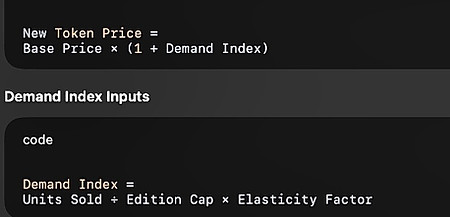
Elasticity Factor
-
Open Tokens: 0.6
-
Limited Tokens: 0.8
-
Master Tokens: 1.0
5. DEMAND-BASED PRICE ESCALATION (TOKEN MIRROR)
Digital demand behaves faster than print, but must be governed.
Price Formula

6. SECONDARY MARKET GOVERNANCE (DIGITAL-ONLY ADVANTAGE)
Unlike print, tokens allow controlled resale.
Rules
-
Royalty floor enforced (artist + platform)
-
Provenance immutable
-
Edition integrity preserved
-
No uncontrolled inflation
This is where digital outperforms physical.


EFA-ARC TOKEN UTILITY OVERLAY
Access • Viewing • Licensing — Governed by Edition Tier
MASTER PROCESS CHAIN (WITH UTILITY)

Utility is not a feature list.
Utility is a controlled entitlement layer that escalates with scarcity.
CORE PRINCIPLE (NON-NEGOTIABLE)
Utility follows scarcity, never precedes it.
Open editions get experience.
Limited editions get capability.
Master editions get authority.
1. ACCESS LAYER (WHO CAN DO WHAT)
Function: Gate participation without fragmenting ownership.
ACCESS TIERS (MIRRORED TO EDITIONS)
OE-D — ACCESS: VIEWER / PARTICIPANT
-
Platform access
-
Collection visibility
-
Event participation (drops, previews, votes)
-
Read-only analytics
Purpose
-
Ecosystem onboarding
-
Network effects
-
Demand signaling
LE-D — ACCESS: MEMBER / CONTRIBUTOR
-
All OE-D access
-
Early access to drops
-
Artist updates & archives
-
Governance-lite (polls, signals)
Purpose
-
Loyalty reinforcement
-
Demand amplification
-
Community stabilization
ME-D — ACCESS: STEWARD / PARTNER
-
All LE-D access
-
Priority access to new Masterworks
-
Direct artist / platform channel
-
Governance authority (curated votes, approvals)
Purpose
-
Institutional alignment
-
Long-term stewardship
-
Supply discipline enforcement
2. VIEWING LAYER (WHERE AND HOW THE WORK LIVES)
This is where ARC outperforms traditional NFTs.
VIEWING RIGHTS STACK

OE-D — VIEWING: STANDARD
-
Web gallery
-
Mobile app gallery
-
Standard resolution
-
No public redistribution
Function
-
Visibility without control
-
Prevents uncontrolled propagation
LE-D — VIEWING: PREMIUM
-
Web + mobile
-
Smart TV gallery (Frame / ARC TV)
-
Enhanced resolution
-
Collector attribution
Function
-
Prestige signaling
-
Social proof
-
Demand acceleration
ME-D — VIEWING: CANONICAL
-
All platforms
-
Highest resolution
-
Featured placement
-
Provenance badge
-
Permanent archive reference
Function
-
Anchor value perception
-
Establish canonical version hierarchy
-
Reinforce master scarcity
3. LICENSING LAYER (MONETIZATION WITHOUT DILUTION)
This is where discipline matters most.
Licensing is never automatic.
Licensing is permissioned and tier-bound.
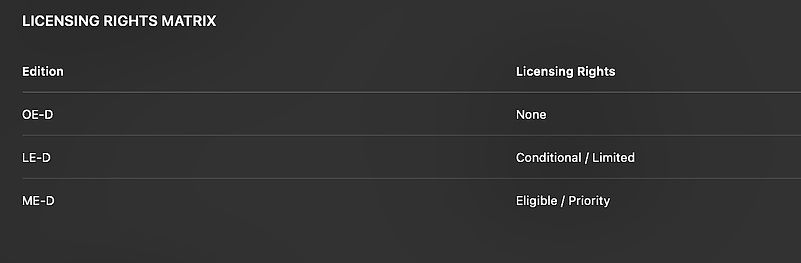
OE-D — NO LICENSING
-
Ownership ≠ usage rights
-
Prevents value leakage
-
Keeps open editions liquid, not extractive
LE-D — CONDITIONAL LICENSING
-
Platform-mediated only
-
Limited scope (editorial, display)
-
Time-bound
-
Revenue split enforced
Purpose
-
Controlled monetization
-
Artist protection
-
Scarcity preservation
ME-D — MASTER LICENSING ELIGIBILITY
-
Eligible for:
-
Commercial licensing
-
Derivative works
-
AI reference pools
-
-
Always platform-governed
-
Never exclusive without explicit contract
Purpose
-
Long-term yield generation
-
Institutional-grade ownership
-
Digital equivalent of master print plates
4. UTILITY SCARCITY MULTIPLIER (HIDDEN BUT CRITICAL)
Utility itself compounds scarcity.

-
Open utility increases demand
-
Limited utility increases retention
-
Master utility increases institutional value
This is why utility must be incremental, not explosive.
5. FEEDBACK LOOP (WHY THIS SYSTEM HOLDS)

The loop feeds back into the Digital Masterwork, not away from it.
WHY THIS WORKS (NO SUGARCOATING)
-
Most NFT projects fail because utility is detached from scarcity
-
Most art platforms fail because ownership has no functional meaning
-
This system avoids both by:
-
Treating utility as infrastructure
-
Treating editions as economic controls
-
Treating tokens as governed instruments, not collectibles
-
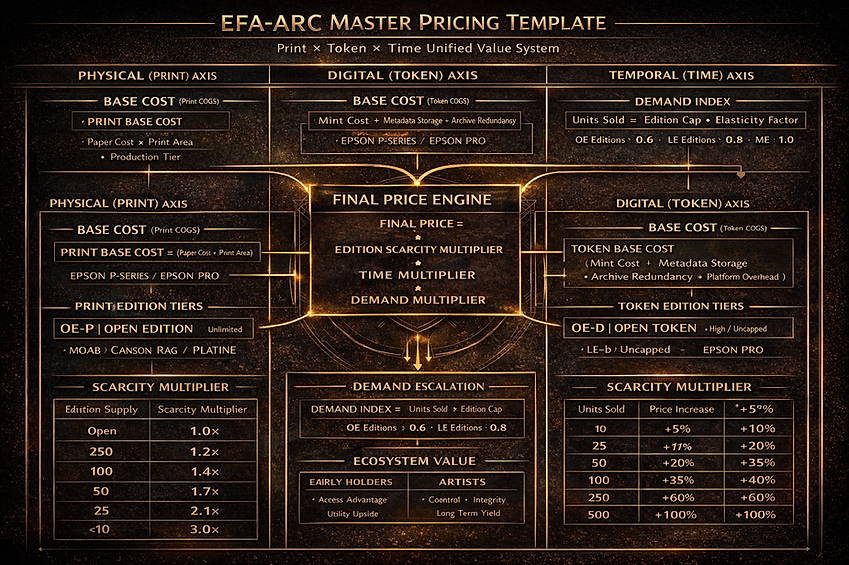
EFA-ARC TIME-BASED UTILITY UNLOCK SYSTEM
Temporal Scarcity • Holder Commitment • Long-Term Alignment
CORE DESIGN PRINCIPLE
Time replaces hype as the unlock mechanism.
No activity farming.
No arbitrary milestones.
No dilution.
Only continuous, verifiable ownership duration.
MASTER PROCESS CHAIN (EXTENSION, NOT REPLACEMENT)

Time becomes a second axis of scarcity, orthogonal to supply.
TIME STATES (UNIVERSAL ACROSS EDITIONS)
Each token progresses through clearly defined aging states.
No jumps. No resets unless transferred.

If a token is sold or transferred:
-
Time resets
-
Utility state resets
-
Scarcity integrity preserved
UTILITY UNLOCK MATRIX (BY EDITION × TIME)
This is where balance is enforced.
OE-D — OPEN TOKEN EDITION
Purpose: Reward patience without turning OE into LE.

Key Rule
OE tokens never gain licensing rights — only privilege and pathway.
This creates retention without collapsing tiers.
LE-D — LIMITED TOKEN EDITION
Purpose: Strengthen scarcity and mid-tier authority.

Key Rule
LE tokens gain capability, not unchecked power.
This reinforces LE as the core economic tier.
ME-D — MASTER TOKEN EDITION
Purpose: Institutional-grade stewardship over time.

Key Rule
ME tokens mature into authority, not speculation.
Time converts ownership into functional leadership.
TIME-BASED SCARCITY MULTIPLIER (HIDDEN ENGINE)
Time amplifies scarcity without touching supply.


This multiplier:
-
Feeds demand algorithms
-
Influences secondary pricing
-
Rewards long-term holders structurally
DEMAND + TIME COMPOSITE INDEX (ADVANCED BUT CLEAN)
We now have two orthogonal value drivers:

-
Demand = market signal
-
Time = conviction signal
This discourages flipping and stabilizes price curves.
HOW THIS MIRRORS PHYSICAL ART REALITY

We’re not inventing behavior — we’re encoding it.
WHY THIS WORKS (STRAIGHT TALK)
Most systems:
-
Reward activity
-
Encourage churn
-
Destroy long-term value
This system:
-
Rewards patience
-
Penalizes speculation
-
Converts holders into stakeholders
Collectors don’t ask:
“What can I do today?”
They ask:
“What does this become if I hold it?”
This answers that without lying.
Tokenization Explained for Artists
(What It Means, How It Works, and Why It Creates Value)
Tokenization is the process of taking a physical work of art and turning it into a certified digital asset that can be tracked, collected, bought, sold, and valued — just like a signed print or limited edition.
Think of it as creating a digital certificate of authenticity + a digital collectible + a trackable asset all in one.
1. It Begins With High-Quality Capture
To tokenize a piece of art, we first need a perfect digital representation of it.
This comes from:
-
high-resolution photography
-
advanced scanning
-
color-calibrated, museum-grade reproduction techniques
-
EFA’s Optical Precision Methodology
This step ensures the digital version is accurate, archival, and trustworthy — the “master file” from which all future value flows.
Without a great capture, there’s no great token.
2. The Digital File Becomes a “Digital Asset”
Once the artwork is photographed, we transform the image into a digital information package.
This includes:
-
metadata (title, artist, year, details)
-
edition size
-
ownership rights
-
provenance log
-
licensing rules
-
rarity and scarcity information
This digital package becomes the foundation of the token — the blockchain-based certificate representing the artwork.
3. Tokenization Puts the Asset on a Secure Blockchain
The digital package is uploaded to a blockchain platform such as:
-
Ethereum
-
Solana
-
Polygon
-
Or EFA’s future ARC-linked token layer
Once placed on the blockchain:
-
it becomes permanently recorded
-
it can’t be forged or duplicated
-
ownership can be transferred at any time
-
every sale is tracked forever
-
the artist automatically earns royalties (if enabled)
The blockchain acts as a global, permanent ledger — like an indestructible provenance book.
4. The Token Gains Value Through Utility & Story
The token is not “just a file.”
It gains value because of the ecosystem around it, such as:
✓ Scarcity
Limited editions increase collectibility.
✓ Authentication
Collectors know exactly who owns what.
✓ Marketing & Brand Narrative
Through EFA-ARC’s cinematic storytelling, social media, exhibitions, documentaries, smart-TV features, and lore integration, tokens gain cultural relevance.
✓ Utility & Perks - Tokens can include benefits such as:
-
print ownership
-
access to exclusive releases
-
artist rewards
-
behind-the-scenes content
-
documentary episodes
-
ARC Universe integration
-
digital frame licensing
-
resale royalties
Each utility increases desirability and long-term value.
5. The Asset Can Grow in Value Over Time
Just like a physical artwork, a tokenized asset grows in value when:
-
the artist’s reputation grows
-
more collectors join the ecosystem
-
demand for that series or style increases
-
the token includes evolving digital perks
-
it is featured in EFA’s marketing, lore, or gallery shows
-
the print editions sell out
-
scarcity continues to rise
-
resale activity increases
The blockchain makes this growth transparent and provable.
In One Sentence: Tokenization is the process of transforming a physical artwork into a secure digital asset that can be authenticated, tracked, collected, marketed, and increased in value across a global digital marketplace.
Complete Process Overview
Goal: Convert a physical artwork into a digitally authenticated asset that can be securely traded, collected, or licensed on the blockchain.
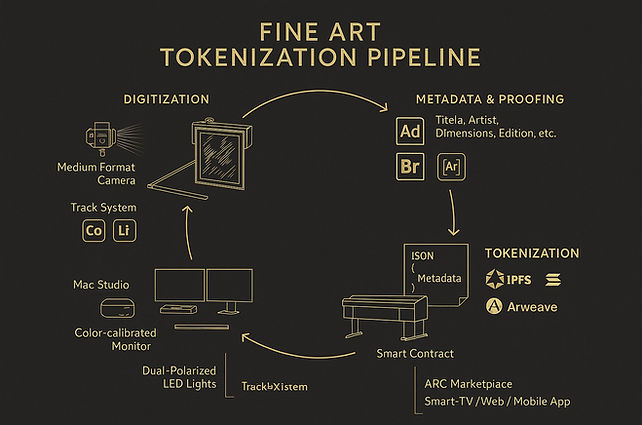
The process has four main stages:
-
Digitization (EFA Optical Precision Methodology)
-
Metadata Creation & Proofing (Color, Dimensions, Edition Data)
-
Blockchain Tokenization (Smart Contract + NFT Minting)
-
Distribution (ARC Marketplace, Smart-TV App, Web, and Mobile)
Stage One — Digitization
Objective - Capture a perfect digital representation of the artwork at museum-grade precision.
Equipment
-
Camera: Medium format (e.g., Hasselblad H6D-100c or Phase One IQ4 150MP)
-
Lens: 80mm or 120mm macro lens
-
Lighting: Dual polarized LED panels (CRI 98+, 5000K)
-
Filters: Linear polarizing filters on both lights and lens
-
Track System: Camera rail system for vertical movement
-
Workstation: Mac Studio or MacBook Pro M-series
-
Monitor: Color-calibrated (Eizo or BenQ PhotoVue series)
-
Software:
-
Capture One or Lightroom for RAW processing
-
Adobe Photoshop for cleanup and proofing
-
X-Rite i1Profiler or Calibrite Display for color calibration
-
Stage Two — Metadata & Proofing
Each digital capture must include authentic metadata embedded into the file.
Metadata Includes
-
Title of artwork
-
Artist name
-
Dimensions
-
Year of creation
-
Capture date
-
Edition size (e.g., 1/10)
-
Capture device info
-
Color profile (ICC)
-
Copyright/ownership data
-
Smart contract ID placeholder
Tools
-
Adobe Bridge or Lightroom for EXIF/IPTC metadata
-
ExifTool for batch embedding metadata
-
AI tagging (Adobe Firefly or ChatGPT Vision integration) for content descriptions
-
Proofing on EFA fine art printers (Epson P9570 / Canon PRO-4100)
Cost - Roughly $20–$50 per file in labor, color management, and storage.
4. Stage Three — Tokenization (Blockchain Minting)
Objective - Convert the verified digital file into a blockchain asset with embedded provenance.
Steps
-
Upload the final high-resolution file to IPFS (InterPlanetary File System) or Arweave (permanent decentralized storage).
-
Generate a unique SHA-256 hash of the file — this ensures authenticity.
-
Create a smart contract (ERC-721 or ERC-1155) on Ethereum, Polygon, or Solana.
-
Embed metadata (JSON) including title, description, artist, and IPFS CID.
-
Mint the token — either manually or via a platform.
-
Assign royalty structure (e.g., 10% back to artist per resale).
-
Store backup data in EFA-ARC Digital Vault and mirror to ARC marketplace.
Software / Platforms
-
OpenZeppelin or Remix IDE for smart contract authoring
-
Pinata or NFT.Storage for IPFS management
-
Alchemy, Moralis, or ThirdWeb for Web3 integration
-
Metamask or Phantom Wallet for wallet management
-
Etherscan or Polygonscan for verification
5. Stage Four — Distribution on the Blockchain
Once minted, the tokenized artwork can be made publicly available and traded.
Publishing Options
-
ARC Marketplace (proprietary smart-contract marketplace powered by EFA-ARC)
-
Public Marketplaces: OpenSea, Rarible, Magic Eden, Foundation
-
ARC Smart-TV / Web / Mobile App — showcasing tokenized artworks with purchasing and streaming capability
-
EFA Vaults — archival collections for collectors and institutions
Integration Stack
-
ARC app (React Native + Web3.js / ethers.js integration)
-
Backend: Firebase + Moralis for user auth and blockchain bridge
-
Smart Contract API via Alchemy/Infura
-
Payment: Stripe, Apple Pay, or crypto wallets
6. Automation & Scaling
-
Once the system is proven, we’ll scale via:
-
Batch minting using ThirdWeb or custom Python scripts
-
AI-assisted metadata tagging
-
Automated IPFS uploads
-
Smart contract templates per artist
-
Integration with the EFA print fulfillment system (token = print edition)
7. Outcome
-
Each tokenized fine-art image becomes:
-
A digitally authenticated collectible (NFT)
-
A royalty-bearing asset on the blockchain
-
A licensable media file for ARC cinematic projects
-
A traceable ledger entry ensuring provenance, authenticity, and value growth
